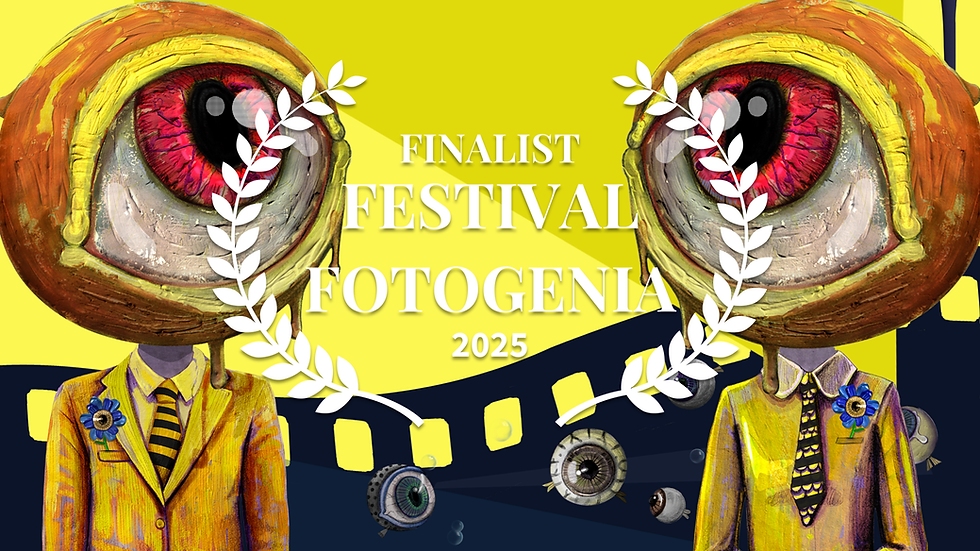
WINNERS 2025
"Normal Lithium," Massimiliano Marianni's elaborate animation, is not simply a film, but a sensory and psychological immersion into the fractured psyche of its central character. The work transports viewers to the surreal and chaotic world of the inner emotions and thoughts of an individual grappling with bipolar disorder, depicted with a raw, lyrical visual style. This approach fosters an experience akin to being literally inside another person's mind, offering unfiltered access to their
most intimate and agonizing thoughts. This forced proximity to the subject creates an atmosphere
of intense intimacy and shared vulnerability. The visual work becomes a personal space that is both oppressive and unsettling, successfully representing a subjective confinement that is not physical,
but mental.
What's more, the animation is distinguished by its skillful and dense combination of visual, auditory, and textual elements. Far from being a mere observer, the viewer, forced to participate, is viscerally drawn into the labyrinth of the protagonist's thoughts and feelings. Marianni employs a series of expressionist techniques that underscore the confusion and emotional torment. The constant use
of erasure techniques in the image not only creates an unstable aesthetic but also simulates the dissolution of reality and memory. The acoustic fragments of phrases and quotes scattered throughout the soundtrack, often overlapping or distorted, act as echoes of intrusive ideas and incessant internal dialogues whose narrative function is to amplify the feeling of psychological pressure. The writing embedded in the film becomes a tangible manifestation of anxiety and the flow of a disordered consciousness. All these elements converge to evoke a palpable sense of emotional confusion and suffocating disorientation. Furthermore, the brilliance of the animation lies in its ability to capture inner emotions and feelings with almost painful precision.
It is significant to note that the bursts of color that sporadically erupt in the film's often more subdued palette offer a vibrant contrast that can symbolize the central character's manic peaks or fleeting moments of clarity. The work is a kind of inner Western—a solitary struggle in the desolate landscape of the mind—multi-referential, touching on themes of identity and madness while defying conventional narrative. Marianni's aesthetic and conceptual approach, as well as his technical mastery, solidifies "Normal Lithium" as a fundamental piece in contemporary animated cinema that tackles mental health with courage and formal innovation. Undoubtedly, it is a very fine exercise in experimental animation that transcends cinepoetry into unexplored, and at the same time, sensual and delirious territories."
Delluc Avant-Garde Winner

"The poetic documentary "La Mancha Negra" (The Black Stain), directed by Yareni Velázquez Mendoza, emerges as a profoundly impactful and memorable cinematic work, distinguished by the intensity and sensitivity of its story. Velázquez Mendoza addresses a deeply emotional experience of discrimination with remarkable delicacy, constructing a unique visual and thematic universe that resonates
long after viewing.
The film unfolds within an atmosphere reminiscent of a claustrophobic dollhouse, an intimate and contained setting that underscores the nature of the experience. The collage animation technique is fundamental to this visual construction, masterfully utilizing fabric cutouts, objects, textures, and photographs to bring the story to life. This combination of materials not only endows the documentary with a unique visual imagery but also reinforces the sense of fragility and the fragmented nature of memory and trauma.
Complementing the visual richness, a carefully crafted voice-over guides the viewer through the events, generating a profoundly personal and resonant impression of what transpired. This synergy between collage technique and audio narration culminates in a powerful testimony that renews the nature of the conventional narrative documentary, becoming a clear example of the vastness
of divergent narratives.
Therefore, "The Black Stain" reveals itself as a reactivation of the genre and a profound reflection through animation, the direct result of a project focused on exploring narratives generated during confinement. The brilliance of the collage animation is not merely technical; it serves a haunting and extraordinarily well-written narrative, rigorously developed and researched, as the documentary demands, but amplified by the creativity of a highly sensitive artistic vision. Thus, Yareni's creative mastery magnifies the story, transforming it into a moving and powerful work of art. This poetic documentary is, without a doubt, a magnificent presentation, deserving of a resounding "Bravo!"
Amero Revelación Award

"This experimental film emerges as a remarkable work within the contemporary cinematic landscape, distinguished by its bold and reflective combination of rigorous formal structure and the ethereal element of water. Ioudina appropriates this universal metaphor—water, an ancestral symbol of change, life, and fluidity—and deconstructs it to imbue it with a completely new and personal resonance. What captivates about this film is its microscopic approach. Ioudina's camera does not limit itself to capturing vast expanses; on the contrary, it delves into detail, exploring the textures, reflections, and surface interactions of the liquid. These shots, sometimes of great intimacy, transform the film into a varied and sophisticated visual game, where surfaces and materials (water, glass, light, debris) become the true protagonists. It is a meditation on matter and being in constant transformation.
Although we have all seen tides, waters, seas, and oceans depicted in countless ways throughout many works, this experimental film manages to be genuinely captivating. The beauty of its images is not only aesthetic but also conceptual, offering a profound impression to the viewer. The work as a whole functions as a mirror reflecting the intrinsic rhythm and ceaseless flow of nature, reminding us of the perpetual dance between calm and chaos. The experience is enriched by lush cinematography, which transforms each frame into a work of art, and a rich, immersive soundscape that complements the visual experience.
Glass and the sea are established as the dialectical axes of this sensory essay. The choice of these elements is not accidental: glass, fragile and transparent, is the material that contains, reflects, and shapes light; the sea, immense and untamed, is the pure manifestation of movement. Through this formal and thematic risk, Ioudina proposes an approach to the external and internal landscape that strips it of its static quality, presenting it as an intrinsically mysterious, protean, and mutable entity. Human remnants that are raw material for the construction of a future. The work is a poetic commentary on regeneration and eternal return."
Jury's Mention

"Zyanya López Arámburo's documentary is a cinematic work of striking poetic beauty and innovative narrative depth. Its aesthetic employs images of lyrical and historical landscapes as a powerful counterpoint to the inescapable harshness of its central theme: the painful and violent expulsion of the Yaqui people from their lands. This aesthetic choice transforms the true story into a profound sensory and emotional experience.
The film is distinguished by a suggestive beauty that invites reflection. Its meticulous attention to detail extends from the visuals to the sound design. The narrative rhythm, intentionally slow and immersive, honours the solemnity of the pain and generates empathy for an entire community.
The film transcends the historical account, delving into the intimate and subjective experience of trauma, articulated through a central character and her ghosts, as a living repository of the wounded collective memory and the dignity of her people. The work offers the viewer a unique space-time where the Yaqui past is an open and throbbing wound that resonates in the present. The tragedy of expulsion becomes universal as a human experience of loss, injustice, and the unyielding dignity and resilience of the spirit. It is a powerful act of remembrance and an artistic statement. It is, without a doubt,
an expanded testimony."
Jury's Mention

"Martin Gerigk's elaborate and artistic short film "Prayer of the Sea" is characterised by its beautiful music, remarkable because the director is also its composer. Furthermore, the cinematography, colour grading, and sound design lend the short film a special audiovisual beauty. Martin demonstrates exceptional skill in working with light and shadow.
However, in the jury's opinion, the exquisite poetry and magnificent music are compromised by
a human presence that at times feels almost excessive, resulting in an imposition that disrupts its abstract elegance and creates a rhythmic distortion.
Nevertheless, it is a captivating short film with its sound and images, and its most significant and surprising aspect is that it forges a coherent vision based on a personal dream. In short, it is an experimental piece of contemporary music that successfully conveys the atmosphere of the author's dream through a modern and cohesive aesthetic, demonstrating intensity and the formal originality
of Martin's mastery."
Jury's Mention

FINALISTS 2025